
Best Espresso Machine for Small Cafes: 2026 Guide

Table of Contents
What Makes an Espresso Machine Right for a Small Cafe
One Group Commercial Espresso Machine: When to Choose Single-Group
Two Group Espresso Machine for Cafe: Scaling Without Overextending
Heat Exchanger vs. Dual Boiler: Temperature Stability and Recovery Time
Commercial Espresso Machine Price: Understanding Total Cost of Ownership
Commercial Espresso Machine Buying Guide: Selection Criteria That Matter
Workflow and Peak-Hour Demand
Water Quality, Filtration, and Plumbing
Build Quality, Warranty, and Repair Access
Refurbished vs. New: Durability and Warranty Considerations
Frequently Asked Questions
Last Updated: October 11, 2026
What Makes an Espresso Machine Right for a Small Cafe
Choosing the best espresso machine for small cafes requires balancing three competing pressures: volume capacity, physical footprint, and total operating costs. A machine that works for a 2,500-customer-per-week operation won't work for a 12,000-customer-per-week operation. And a machine that needs 6 feet of counter space doesn't fit in an 800-square-foot shop.
The reality: most cafe owners underestimate how much machine capacity they actually need during peak hours. A single-group machine that pulls shots fine at 10 a.m. chokes when you're serving 40 customers between 7 and 9 a.m. The water doesn't heat fast enough. The portafilter stays too cool. Your barista spends more time waiting for the machine than pulling shots.
At Highpockets Coffee, we understand that the owners who succeed pick machines calibrated to their peak-hour demand, not their average demand. That's the throughline we'll use to evaluate every option below.
This guide covers the essential decision points: single-group versus two-group configurations, heat-exchanger versus dual-boiler systems, and the often-overlooked total cost of ownership that separates a bargain from a genuine investment.
One Group Commercial Espresso Machine: When to Choose Single-Group
A single-group espresso machine pulls one shot at a time. It's the compact option, the machine that fits in a small space and doesn't overwhelm a solo barista or a two-person team.
Single-group machines make sense if your cafe serves fewer than 200 espresso drinks per day during peak hours. That's roughly 30-40 drinks per hour, which one barista can handle with a well-maintained machine and a clear workflow.

Where single-group machines fall short: they don't scale. Once you're consistently slammed, say, 50+ drinks per hour, a single group becomes a bottleneck.
The other limitation is workflow. With one group, your barista must pull shots, steam milk, and hand off drinks in strict sequence. There's no parallel work.
For a very small independent cafe, think 600-800 square feet, 2-3 staff during peak, a single-group machine from a reputable manufacturer can work. Just be honest about your volume first.
Two Group Espresso Machine for Cafe: Scaling Without Overextending
A two-group espresso machine has two group heads. Two baristas can pull shots simultaneously, or one barista can manage both groups with proper sequencing. This is where most small cafes actually find their sweet spot.
Two-group machines handle 400-600 espresso drinks per day comfortably. That's 60-90 drinks per hour during peak service, realistic for a busy independent cafe with consistent morning and afternoon rushes. The machine recovers fast enough that your barista isn't waiting on heating cycles.
The footprint is manageable. A two-group machine typically occupies 3-4 feet of counter space, which fits most small cafe layouts. It's not a massive La Marzocco that requires dedicated electrical and plumbing infrastructure.
What matters most with a two-group setup: the boiler system. A heat-exchanger boiler (covered below) costs less and takes up less space.
Two-group machines also signal to your customers that you're serious about quality. You're not cutting corners with a single group. You've invested in proper equipment. That perception matters, especially in competitive markets where customers have choices.
Heat Exchanger vs. Dual Boiler: Temperature Stability and Recovery Time
This is where the engineering gets real. Both systems heat water. Both systems pull shots. The difference is in how they manage temperature and how fast they recover between drinks.
A heat-exchanger boiler uses a single large boiler to heat water for both espresso extraction and steam.
The tradeoff: temperature stability is harder to achieve. Espresso extraction is sensitive to water temperature, a difference of 5 degrees Fahrenheit can change the shot's taste. Heat-exchanger machines require skill from your barista.
Recovery time is also slower. After steaming milk, the boiler temperature spikes. You need a few seconds before the next espresso shot pulls at the right temperature.
A dual-boiler system has two separate boilers: one for espresso, one for steam. Each runs at its own temperature. The espresso boiler stays stable at 200-205 degrees Fahrenheit.
Recovery time is instant. Finish steaming milk, pull the next shot immediately. The espresso boiler was never affected.
The cost difference is real. Dual-boiler machines cost more to buy and more to repair. But if your cafe's reputation depends on shot consistency, and it should, dual-boiler is worth the investment.
Commercial Espresso Machine Price: Understanding Total Cost of Ownership
This is where most cafe owners make their biggest mistake. They look at the sticker price and stop thinking.
A commercial espresso machine is not just the purchase price. It's the electrical work to install it. The plumbing to get water in and waste water out.
Real total cost of ownership includes:
Installation and setup. Plan on spending 15-30% of the machine's purchase price on getting it plumbed and wired properly. A machine installed wrong will fail early and cost more to fix.
Water filtration. Tap water contains minerals that build up inside the boiler.
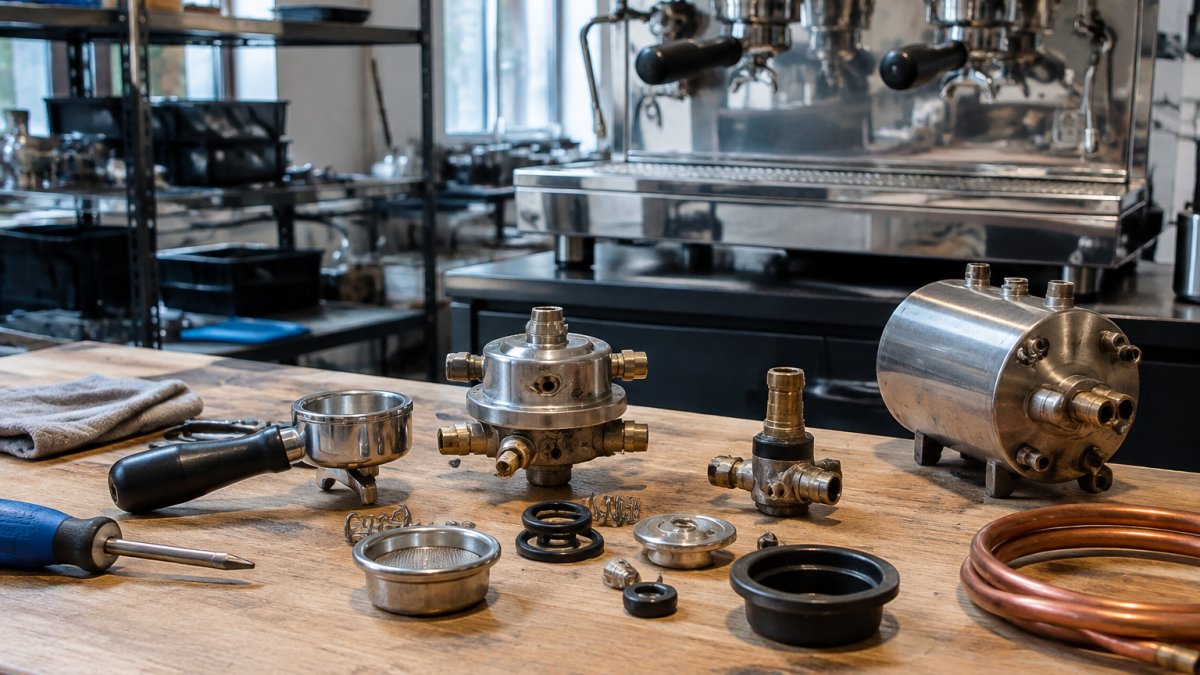
Maintenance and parts. A commercial machine needs cleaning, descaling, and regular maintenance. Group head gaskets wear out. Pump seals fail. Heating elements eventually die. Budget for annual maintenance and occasional parts replacement.
Downtime. When your machine breaks during the morning rush, you lose revenue. If your repair service takes 3 days to show up, that's 3 days of lost sales.
Depreciation. A used machine loses value faster than a new one. If you're financing the purchase, you need to know what the machine will be worth in 5 years.
New machines from established brands (Nuova Simonelli, La Marzocco, Victoria Arduino) typically hold their value better than off-brand machines. Refurbished machines cost less upfront but may have higher maintenance costs in years 2-3.
Commercial Espresso Machine Buying Guide: Selection Criteria That Matter
Choosing the best espresso machine for small cafes comes down to answering four questions in order: What's your peak-hour volume? How much counter space do you have? What's your actual budget including installation and 3 years of maintenance? And do you have reliable repair support nearby?
Workflow and Peak-Hour Demand
Peak-hour demand is the number of espresso-based drinks you need to serve in a single hour during your busiest time. Most cafes have a 2-3 hour morning rush and a 1-2 hour afternoon rush.
Count your drinks for a week. Add up espresso shots across all drinks (cappuccinos, lattes, macchiatos, Americanos, flat whites). Divide by the number of peak hours. That's your baseline.
Now add 20% for growth. You're buying equipment for where you'll be in 2 years, not where you are today.
If your peak-hour demand is 30-50 drinks, a single-group machine works. If it's 50-90 drinks, go two-group. If it's 90+, you need a three-group or you need two machines.
Be honest about this number. It's the single most important variable in your decision. An undersized machine will frustrate your baristas and limit your revenue. An oversized machine wastes counter space and money.
Water Quality, Filtration, and Plumbing
Commercial espresso machines are picky about water. Hard water (high mineral content) clogs the boiler and shortens the machine's life by years. Soft water (low mineral content) can corrode internal parts.
The ideal water has a specific mineral balance. That's why filtration matters. A basic carbon filter removes chlorine and sediment. A water softener removes minerals. Some cafes use reverse osmosis, which removes everything and requires remineralization. Others use a combination.
Your plumbing also matters. The machine needs a water line coming in and a drain going out. If your cafe doesn't have those already, installation costs spike. Some machines can use a gravity-fed water reservoir instead of a plumbed-in line, but that requires refilling the reservoir daily and limits your volume.
Ask your installer or machine supplier: what filtration system do they recommend for your local water? Don't skip this step. It's the difference between a machine that lasts 10 years and one that fails in 5.
Build Quality, Warranty, and Repair Access
Commercial machines are built to different standards. Some are built to last 15+ years with proper maintenance. Others are built to last 5-7 years and then you replace them.
Reputable brands (Nuova Simonelli, La Marzocco, Victoria Arduino, Rocket Espresso) use heavier gauge steel, better pumps, and more durable heating elements. They cost more upfront, but they hold up to daily commercial use.
Warranty matters, but so does repair access. A 3-year warranty is standard. What matters more is whether a repair technician can get to you fast when something breaks. If you're in a remote area, or if your machine brand doesn't have local service, you're stuck.
At Highpockets Coffee, we understand that downtime costs cafe owners real money. When you buy from a supplier, ask: who fixes this machine if it breaks? How fast can they get here? What's the cost of a service call?
Refurbished vs. New: Durability and Warranty Considerations
A refurbished machine is a used machine that's been inspected, cleaned, and tested. Internal parts that wear out (gaskets, seals, heating elements) are typically replaced. The machine is then sold at a discount, usually 30-50% less than new.
Refurbished machines make sense if:
You're budget-constrained and can't afford a new machine
You're starting a second location and want to test the concept before investing in new equipment
You're buying from a reputable supplier who stands behind the refurbished unit
Refurbished machines carry risk if:
You buy from an unknown seller with no warranty or support
The machine is older (8+ years) and may have hidden wear
You don't have a reliable repair service nearby
The warranty on a refurbished machine is typically shorter, 1 year instead of 3 years. That means if something breaks in year 2, you're paying for the repair yourself.
Here's the honest take: a well-refurbished machine from a trusted supplier is a reasonable choice. A cheap refurbished machine from an unknown seller is a gamble. The difference between the two is often just $1,000-2,000, which is worth paying to avoid the risk.
At Highpockets Coffee, our refurbished Nuova Simonelli machines are inspected and serviced before sale. We stand behind them with repair support.
Choosing the best espresso machine for small cafes is a decision that affects your daily operations and your bottom line for years. At Highpockets Coffee, we carry a full range of Nuova Simonelli espresso machines in single-group, two-group, and larger configurations, including refurbished options for budget-conscious owners, backed by expert repair services and wholesale espresso beans to keep your operation running smoothly.
Frequently Asked Questions
What is the best espresso machine for a small cafe?
The best espresso machine for a small cafe depends on your peak-hour volume and counter space. Single-group machines work well for cafes serving 50-100 drinks daily, while two-group machines handle 150-250+ drinks. Look for machines with temperature stability, reliable steam output, and accessible repair services. Nuova Simonelli machines are built for small commercial environments with durability and consistent extraction.
How many group heads does a small cafe need?
Most small cafes thrive with one or two group heads. A single-group machine suits cafes with 800-1,200 square feet and moderate traffic. Two-group machines work for cafes with higher peak-hour demand or limited staff. Consider your busiest hours: if you're pulling more than 15-20 shots per hour during rush, a two-group setup reduces customer wait times and barista stress.
How much does a commercial espresso machine cost?
Commercial espresso machine pricing depends on group count, boiler type, and whether you choose new or refurbished equipment. Contact Highpockets Coffee for current pricing and financing options tailored to your cafe's needs.
Should I buy refurbished or new espresso equipment?
Refurbished espresso machines from reputable suppliers like Highpockets Coffee deliver reliability at lower cost. Quality refurbished units are professionally reconditioned, tested, and backed by warranties. For small cafes on tight budgets, refurbished equipment can extend your equipment budget to include a grinder, steam wand upgrades, or backup supplies. Verify warranty coverage and repair access before purchasing.
What should I look for in a commercial espresso machine?
Prioritize temperature stability, which ensures consistent shot extraction and espresso quality. Check the steam wand power for your milk-based drinks volume. Verify the machine's warm-up time and recovery time between shots. Confirm water filtration compatibility and whether the machine can be plumbed directly to your water line. Finally, ensure the manufacturer or supplier offers accessible repair services and parts availability in your area.
Request A Quote

Comments