
Espresso Machine Repair Response Time: A Guide

Table of Contents
Understanding Espresso Machine Repair Response Time
Factors That Affect Repair Turnaround
Emergency vs. Non-Urgent Repair Scheduling
Preventative Maintenance for Coffee Equipment
Commercial Espresso Machine Maintenance Schedule
Espresso Machine Service Level Agreement Expectations
How to Prepare Your Machine for Service
Frequently Asked Questions
Last Updated: September 28, 2026
Understanding Espresso Machine Repair Response Time
Espresso machine repair response time is the window between when you report a problem and when a technician arrives to diagnose and fix it. For most service providers, this spans 24 to 72 hours for standard repairs. Emergency calls during peak business hours can be faster, sometimes same-day, but availability depends heavily on your location and the service provider's capacity.
Response time matters because every hour your machine sits broken costs you sales. A cafe doing 200 drinks per day loses revenue fast.
Factors That Affect Repair Turnaround
The complexity of your problem, your location, and whether parts need to be ordered all shape how long the espresso machine repair response time actually is.
Machine complexity and repair scope matter most. A simple gasket replacement takes 30 minutes and can often be done same-day if the technician has the part in stock. A pump rebuild takes three to four hours and typically requires a workshop visit. A boiler leak requiring replacement is a week minimum. When you call for service, describe what the machine is doing, leaking water, producing no espresso, steaming weakly, or not heating up. Ask the service provider for a time estimate before they arrive; reputable providers will ask diagnostic questions over the phone and provide a ballpark range.
Your geography affects availability and response speed. Urban areas typically offer 24-48 hour response times for standard repairs. Suburban areas see 48-72 hours. Rural locations more than 30 miles from a service hub may wait 5-7 days. If you're rural, build a relationship with a provider who serves your region and schedule preventative maintenance during their regular route visits.
Seasonal demand swings response times dramatically. Summer is slow; winter (November-January) is chaos. If your machine breaks in December or January, expect 5-7 day waits instead of 48-72 hours. Schedule preventative maintenance in September or October when service providers have open slots.
Parts availability changes the timeline from hours to weeks. Common parts like gaskets and shower screens ship in 1-2 days. Specialty parts, boilers for older machines or imported components, can take 10-14 days. Established providers with large installed bases carry common parts and often fix machines same-day. Ask your service provider what parts they stock and their lead time for parts they don't have on hand.
Machine age and condition affect diagnostic time. Newer machines with standard components are faster to diagnose and repair because parts are readily available. Older machines may require longer diagnostic time because parts are harder to source.
Your maintenance history directly impacts response time. Well-maintained machines are faster to diagnose and repair. Neglected machines take longer because the technician must assess accumulated damage, potentially adding 2-3 hours to the service call.
Emergency vs. Non-Urgent Repair Scheduling
Emergency repairs happen when the machine won't produce espresso or steam. Most service providers charge 50% premiums for same-day or after-hours calls. Plan for that in your budget.
Non-urgent repairs include slow extraction, weak steam, inconsistent temperature, and cosmetic damage. You can schedule these for the next available weekday slot, typically three to five days out.
Scheduled maintenance isn't a repair. Book these months in advance. Many service providers discount scheduled maintenance because they can plan their routes efficiently.
An emergency call gets a technician to you faster than a routine service request, but costs more and should be rare.
Preventative Maintenance for Coffee Equipment
Preventative maintenance is the single best way to avoid emergency repairs and long espresso machine repair response time.
Daily maintenance takes five minutes per shift: run water through the group head after each shot, backflush the portafilter, empty the drip tray, and wipe the steam wand. This prevents 80% of common problems.
Weekly maintenance includes soaking the shower screen and dispersion plate in espresso machine cleaner, then backflushing with cleaner and water until clear. This prevents oil buildup that clogs the group head.
Monthly professional descaling removes mineral deposits from the boiler and heat exchanger.
Commercial Espresso Machine Maintenance Schedule
Commercial espresso machine maintenance schedule varies by machine age, water quality, and usage volume. But a standard framework works for most businesses.
Daily:
Run water through the group head between shots
Backflush the portafilter after each use
Wipe the steam wand after each milk drink
Empty the drip tray
Weekly:
Deep clean the shower screen and dispersion plate
Backflush with cleaning solution
Check water pressure gauge (should read between 8-9 bar)
Monthly:
Professional descaling service
Check gaskets and seals for wear
Test steam function and temperature stability
Quarterly:
Inspect pump pressure
Check boiler condition
Review extraction times on test shots
Annually:
Full machine inspection
Replace gaskets if needed
Service the pump and motor
Calibrate the group head if applicable
Espresso Machine Service Level Agreement Expectations
A good SLA includes:
Response time commitment. The provider promises to arrive within 24 hours for emergency calls, 48-72 hours for standard repairs. If they miss the window, you get a discount or credit.
How to Prepare Your Machine for Service
When the technician arrives, having your machine ready speeds up the process and can shorten espresso machine repair response time by 30 minutes or more. But preparation extends beyond the physical machine, it includes setting clear expectations for communication and understanding what happens if your machine needs to leave your location for workshop repair.
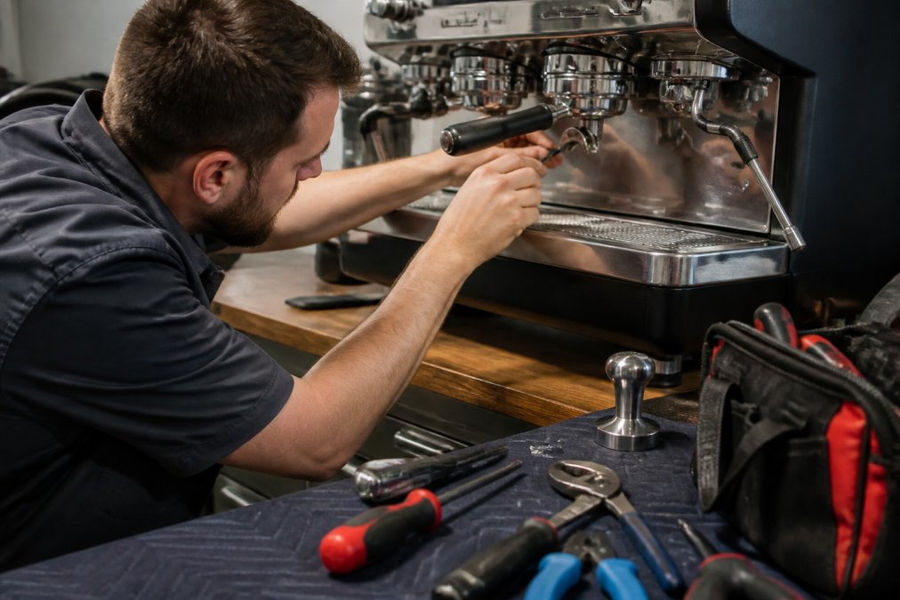
Before the technician arrives:
Turn off the machine and let it cool for 15 minutes
Empty the water tank and drip tray Request A Quote →
Remove the portafilter and group screen
Clean out any loose coffee grounds or debris
Note exactly what the machine was doing wrong (slow extraction, no steam, leaking, etc.)
Have the machine's model number and serial number ready
Clear a work space around the machine for the technician's tools
Ask the service provider in advance: Will they diagnose on-site or take the machine to the workshop? If they take it, how will it be transported and insured?
"What is your standard communication schedule? Will you call me with updates, or do I need to call you?" (Best practice: daily updates if the machine is at the workshop, or a call within 24 hours of diagnosis.)
"If you find additional problems during repair, will you call me before proceeding, or do you have a cost ceiling I should set?" (Prevents surprise $800 invoices for problems discovered mid-repair.)
"What is your estimated completion date, and what happens if you miss it?" (Reputable providers will give you a specific date and explain what delays might occur.)
"How can I check on the status of my repair?" (Ask for a direct phone number or email contact, not just a general shop line.)
"If parts need to be ordered, will you notify me of the delay and give me a revised timeline?" (Prevents the "radio silence for a week" scenario.)
During the service call:
Stay nearby to answer questions about how the machine has been behaving
Show the technician your maintenance logs if you keep them
Ask what caused the problem and how to prevent it in the future
Get a written estimate before major repairs proceed
Ask about the warranty on any parts replaced
Confirm the communication schedule and completion date before they leave
Ask about transport. Does the provider pick up and deliver, or do you arrange shipping? If you arrange shipping, ask for their preferred carrier and whether they have a preferred packing method. (Most espresso machines should be shipped in a wooden crate or heavy-duty cardboard box with at least 4 inches of foam padding on all sides.)
Confirm insurance. Ask whether the machine is covered under the service provider's insurance during transport and repair, or whether you need to purchase additional coverage. Most carriers offer declared-value insurance for $50-$150 depending on machine value. This is worth the cost for a $3,000+ machine.
Get a pickup and delivery timeline. Don't assume "we'll pick it up tomorrow." Ask for a specific date and time window. If the provider can't commit to a date, that's a red flag about their capacity.
Request a condition report. When the machine arrives at the workshop, ask the provider to photograph the machine's condition and send you photos. This protects you if the machine is damaged in transit, you have proof of what condition it arrived in.
Set a repair completion deadline. Ask: "If you can't complete the repair within 7 days, will you provide a loaner machine or credit my account for the downtime?" Machines in the shop for 10+ days without communication are a common complaint.
After the service call:
Ask the technician to show you the replaced part so you understand what failed
Get a detailed receipt listing what was replaced and the labor time
Ask when the next maintenance visit should be scheduled
Request a copy of the service report for your records
If the machine was at the workshop, ask for a summary of what was done and why
Set a calendar reminder for your next preventative maintenance visit
Frequently Asked Questions
What is a reasonable response time for commercial espresso machine repair?
Most authorized service centers aim for 24-48 hours for non-emergency repairs and 4-6 hours for emergency calls during business hours. Response times depend on technician availability, machine location, and repair complexity. Machines located in major service areas typically see faster response, while remote locations may experience longer waits. Establishing a service level agreement with your provider sets clear expectations upfront.
How can preventative maintenance for coffee equipment reduce repair emergencies?
Regular descaling, gasket replacement, and pump pressure checks catch wear before failures occur. A preventative maintenance schedule performed monthly or quarterly prevents extraction issues, steam function problems, and boiler maintenance emergencies. Businesses that follow a structured maintenance plan report fewer unexpected downtime incidents and extend machine life expectancy by years, reducing overall repair costs.
What should I include in a commercial espresso machine maintenance schedule?
A maintenance schedule should include weekly backflushing, monthly descaling and gasket inspection, quarterly pump pressure testing, and annual professional servicing. Document all maintenance in writing to track machine performance and warranty compliance. Scheduling maintenance during slower business hours minimizes disruption. Authorized service centers can recommend a customized schedule based on your machine model and daily volume.
How does equipment age affect espresso machine repair response times?
Older machines may require longer repair times because technicians need to source replacement parts, diagnose unfamiliar issues, or perform more extensive troubleshooting. Newer machines with common parts availability typically see faster turnaround. However, well-maintained machines of any age respond quickly to service. Warranty period coverage and part availability vary by age, so confirming your machine's service history with your provider helps set realistic timelines.
Request A Quote


Comments